
Understanding 5G: Technology, Safety, Peer-Reviewed Studies, and Conspiracy Theories

**(Disclaimer: Artificial Intelligence Information and article-generated material)**
What is 5G?5G, the fifth generation of wireless network technology, represents a significant leap forward in telecommunications, designed to meet the growing demand for faster, more reliable connectivity. Deployed globally since 2019, 5G offers enhanced mobile broadband, ultra-low latency, and the ability to connect a massive number of devices simultaneously, paving the way for innovations like smart cities, autonomous vehicles, and advanced telemedicine. Unlike its predecessors (2G, 3G, 4G), 5G operates across a broader spectrum of radio frequencies, divided into three main bands
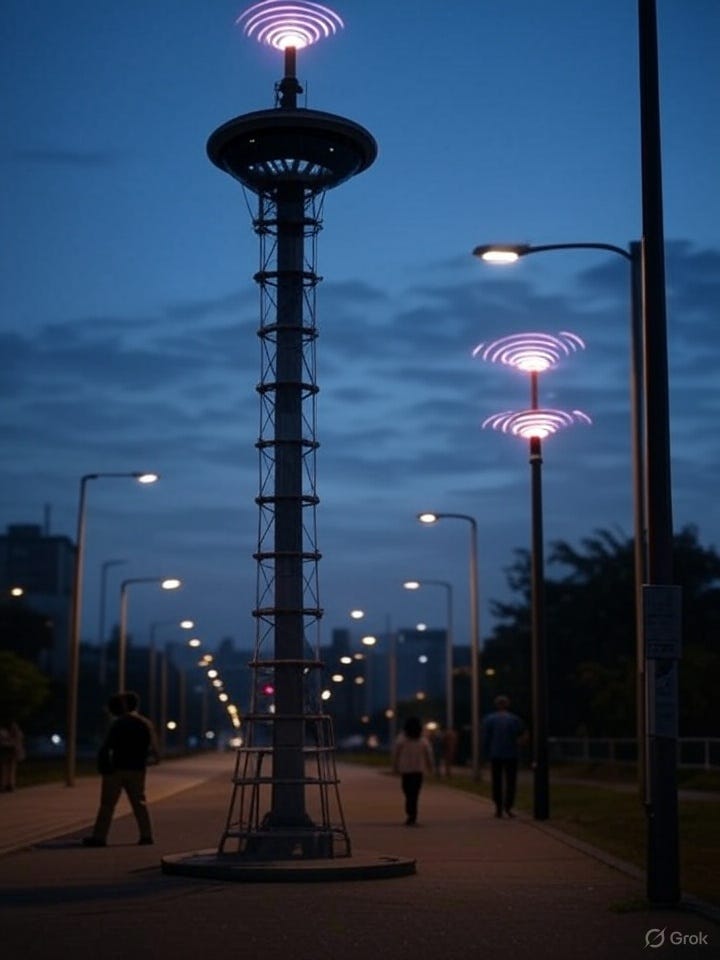
:
Low-Band (600–900 MHz): Provides wide coverage (up to 10 miles) but lower speeds (50–250 Mbps). It’s ideal for rural areas and penetrates obstacles like walls effectively.
Mid-Band (1–6 GHz, typically 2.5–3.7 GHz): Balances speed (100–900 Mbps) and coverage (1–3 miles), widely used in urban and suburban settings. This is the most common 5G band globally.
High-Band (Millimeter Wave, 24–40 GHz): Delivers ultra-fast speeds (1–10 Gbps) and low latency (1–12 ms) but has a short range (50–2,000 feet) and poor penetration, requiring small cells in dense areas like stadiums or city centers.
5G’s architecture relies on advanced technologies like Massive MIMO (Multiple Input Multiple Output, using 64–256 antennas) and beamforming, which directs focused RF beams to specific devices, improving efficiency and reducing environmental exposure compared to 4G’s omnidirectional broadcasts. Small cells, often mounted on streetlights or buildings, are critical for mmWave deployment, while macrocell towers handle low- and mid-band frequencies.Is 5G Harmful?The safety of 5G has been a topic of intense debate, fueled by concerns about radiofrequency electromagnetic fields (RF-EMF) and their potential effects on humans, animals, plants, and insects. RF-EMF is non-ionizing, meaning it lacks the energy to break DNA or cause direct cellular damage, unlike ionizing radiation (e.g., X-rays). The primary known effect of RF-EMF is thermal (tissue heating), which is mitigated by strict exposure limits set by the International Commission on Non-Ionizing Radiation Protection (ICNIRP) and other bodies like the IEEE. Below, we explore the safety of 5G based on peer-reviewed studies and address conspiracy theories.Safety GuidelinesICNIRP’s 2020 guidelines (Health Physics, DOI: 10.1097/HP.0000000000001139) set exposure limits to prevent thermal effects:
Humans: Specific Absorption Rate (SAR) of 2 W/kg (head/torso, localized) and 0.08 W/kg (whole-body) for the public; power density <10 W/m² (2–300 GHz).
Occupational: Higher limits (10 W/kg localized, 50 W/m²) for trained workers.
5G tower emissions typically measure <0.1 W/m² in public areas, and phone SAR is kept below 2 W/kg, well within safe limits. mmWave’s shallow penetration (1–2 mm, skin-only) further reduces systemic risks.
Peer-Reviewed Studies on 5G SafetyHumansDecades of research on RF-EMF, primarily from 2G–4G (0.9–2.4 GHz), inform 5G safety assessments, as 5G’s low/mid-bands overlap these frequencies. mmWave (24–40 GHz) studies are emerging but limited due to 5G’s recent rollout. Key studies include:
ICNIRP Review (2020, DOI: 10.1097/HP.0000000000001139): Synthesized data on 0.1–300 GHz, including 5G. Found no evidence of adverse effects (e.g., cancer, neurological issues) below exposure limits. mmWave’s skin-limited penetration minimizes deeper tissue effects.
National Toxicology Program (NTP, 2018, DOI: 10.22427/NTP-TR-595): Exposed rats to 900 MHz–1.9 GHz at 6 W/kg (75x human whole-body limit). Found “clear evidence” of heart schwannomas and “some evidence” of brain gliomas in male rats, but results were inconsistent across sexes/species and not directly applicable to 5G due to extreme exposures.
Interphone Study (2010, DOI: 10.1093/ije/dyq079): A multinational case-control study found no consistent glioma risk from mobile phone use, though heavy users (>1,640 hours) showed a slight, non-significant risk increase, possibly due to recall bias.
Karipidis et al. (2021, DOI: 10.1038/s41370-021-00247-8): Reviewed 107 studies on mmWave (6–100 GHz). Found no consistent evidence of genotoxicity, cell proliferation, or other bioeffects at low levels. Many studies had poor methodology, and reported effects were often thermal or unconfirmed.
Constructor University Study (2025, PNAS Nexus): Exposed human skin cells to 27–40.5 GHz at 10x ICNIRP limits. Found no changes in gene expression or methylation, reinforcing mmWave safety due to shallow penetration.
Follow the blog at Conspiracy@ Unearthed
Follow on X @ Conspiracy Unearthed
Follow on Facebook @ Conspiracy Unearthed
Follow my posts on YouTube @ Conspiracy Unearthed
Conclusion: No peer-reviewed studies show 5G causing harm to humans at typical exposures. Claims of cancer or blood-brain barrier disruption (e.g., Salford et al., 2003, DOI: 10.1289/ehp.6039) are not replicated or use unrealistic exposures.AnimalsAnimal studies focus on mammals (rats, mice) and occasionally other species, with limited 5G-specific data:
NTP (2018): As above, found heart schwannomas in male rats at 6 W/kg, irrelevant to 5G’s lower environmental levels (<0.01 W/kg).
Falcioni et al. (2018, DOI: 10.1016/j.envres.2018.01.037): Ramazzini Institute reported slight heart schwannoma increases in rats at 0.1 W/kg (1.8 GHz), but results were inconsistent and criticized for small sample sizes.
Simkó & Mattsson (2019, DOI: 10.3389/fpubh.2019.00223): Found no consistent animal harm at mmWave levels (<0.1 W/m²). mmWave’s skin-limited effects reduce systemic risks.
Cucurachi et al. (2013, DOI: 10.1016/j.envint.2012.10.009): Reviewed wildlife effects (0.1–6 GHz). Some behavioral changes (e.g., bird nesting) at >10 W/m², but no harm at 5G-like levels.
Conclusion: No evidence of animal harm from 5G at environmental exposures. Extreme lab conditions (e.g., NTP) don’t reflect real-world scenarios.InsectsInsects, due to small body sizes, may absorb more RF at higher frequencies:
Lazaro et al. (2016, DOI: 10.1007/s13592-016-0436-1): Bees exposed to 900 MHz–2.4 GHz showed navigational issues at >10 W/m², not seen at 5G levels (<0.1 W/m²).
Thielens et al. (2018, DOI: 10.1038/s41598-018-22271-3): Modeled insect absorption at 2–120 GHz. Found higher absorption at mmWave but no harm at environmental levels.
Chironomidae Study (2019, DOI not specified): Reported DNA effects in insects at 64–69 GHz (<6 mW/cm²), but results were not replicated and used small samples.
Conclusion: No confirmed insect harm from 5G. High-frequency absorption is possible but requires intensities >100x typical 5G emissions.PlantsPlant studies are sparse, especially for 5G:
Czerwiński et al. (2020, DOI: 10.1016/j.envres.2020.109887): Found no significant effects on crops (beans, wheat) at 900 MHz–2.4 GHz below 10 W/kg. Typical 5G levels (<0.1 W/m²) are far lower.
Vian et al. (2016, DOI: 10.1080/15592324.2015.1120956): Tomato plants showed transient stress at 900 MHz (>5 W/kg), but no lasting harm.
Waldmann-Selsam et al. (2016, DOI: 10.1016/j.scitotenv.2016.05.207): Claimed tree damage near RF sources (900 MHz–1.8 GHz) but was debunked by ICNIRP, WHO, and Czerwiński et al. for lacking controls and ignoring confounders (e.g., pollution, pests).
Conclusion: No peer-reviewed evidence shows 5G harming plants. Claims of tree damage are unreliable and not 5G-specific.Conspiracy Theories Surrounding 5G5G has been the target of numerous conspiracy theories, particularly amplified during the COVID-19 pandemic. These theories, often spread on social media platforms like X, lack scientific backing but have caused real-world harm, including arson attacks on cell towers. Key claims include:
1. 5G and COVID-19: A 2020 theory linked 5G to the SARS-CoV-2 outbreak, alleging it weakens immune systems or directly spreads the virus. This originated from a January 2020 tweet claiming Wuhan’s 5G rollout caused the pandemic (PMC, DOI: 10.2196/19231). Debunked by WHO (www.who.int, 2020) and others, as viruses cannot travel via radio waves, and COVID-19 spread in areas without 5G (e.g., Iran). A 2020 study (PMC, DOI: 10.2196/19231) found 34% of Twitter users believed this theory, with arson attacks in the UK, Netherlands, and Canada linked to it (Wikipedia, 2021).
2. 5G Kills Birds/Insects: Claims of mass bird or bee deaths due to 5G are unfounded. A 2020 Dutch incident was attributed to poisoning or collisions, not 5G (UNICEF Montenegro, 2020). No studies show RF-EMF above 10 MHz harming birds (Wikipedia, 2021).
3. 5G Causes Cancer/Other Diseases: Critics like the Environmental Health Trust (ehtrust.org, 2017) cite studies like NTP or Hardell (2019) to claim RF-EMF causes cancer or neurological disorders. These studies use high exposures or have methodological flaws, and mainstream science (ICNIRP, WHO) finds no consistent evidence (Full Fact, 2025).
4. Microchip Implants: A 2021 U.S. survey found some believed 5G or COVID-19 vaccines implant microchips, a baseless claim fueled by distrust in institutions (Wikipedia, 2021).
These theories thrive due to mistrust in institutions, amplified by figures like InfoWars or celebrities (PMC, DOI: 10.2196/19231). Arson attacks (e.g., 90 in the UK, 7 in Canada) and protests in Australia and the Netherlands reflect their impact (Wikipedia, 2021). Fact-checking by Snopes, Full Fact, and scientific reviews counter these claims, emphasizing 5G’s safety within ICNIRP limits.
Number of 5G Towers in the United StatesPrecise counts of 5G towers are challenging due to rapid deployment and varying definitions (macrocells vs. small cells). As of April 2023, the U.S. had 5G coverage in 503 cities, with estimates of 5G base stations (including macrocells and small cells) ranging from 100,000 to 200,000 by 2024:
CTIA (2023): Reported over 100,000 5G base stations, with carriers like Verizon, AT&T, and T-Mobile expanding rapidly. Small cells, critical for mmWave, number in the tens of thousands in urban areas.
FCC and Industry Estimates: The U.S. had ~417,000 total cell sites (4G/5G) in 2022, with 5G comprising a growing share. T-Mobile’s 2.5 GHz mid-band covers 320 million people, while Verizon’s mmWave is deployed in 60+ cities.
Challenges: Small cell counts are often underreported, as they’re installed on existing infrastructure (e.g., streetlights). Rural low-band 5G relies on fewer macrocells.
A conservative estimate places the U.S. at ~150,000 5G base stations (macrocells and small cells) as of late 2024, with continued growth expected.Conclusion5G is a transformative technology enabling faster connectivity and new applications, operating across 0.6–40 GHz with advanced features like beamforming. Peer-reviewed studies, including ICNIRP (2020), Karipidis et al. (2021), and Constructor University (2025), show no consistent evidence of harm to humans, animals, plants, or insects at typical exposure levels (<0.1 W/m², <2 W/kg). Studies like NTP (2018) reporting tumors used extreme exposures irrelevant to 5G. Conspiracy theories linking 5G to COVID-19, cancer, or ecological harm lack scientific support and have fueled destructive acts like tower arson. The U.S. has ~150,000 5G base stations, with ongoing expansion. While long-term 5G-specific data is still emerging, current evidence supports its safety within established guidelines. Continued research, like the EU’s GOLIAT project, will further clarify 5G’s impacts, but for now, the consensus is clear: 5G poses no significant risk at current exposure levels.
**(Disclaimer: Artificial Intelligence Information and article-generated material)**
I’m on @buymeacoffee. If you like my work, you can buy me one and share your thoughts 🎉☕ https://buymeacoffee.com/conspiracyunearthed
OR