
The Emerging Machine State
Data Centers, Brain Interfaces, Digital Identity, and the Architecture of a New Technocracy

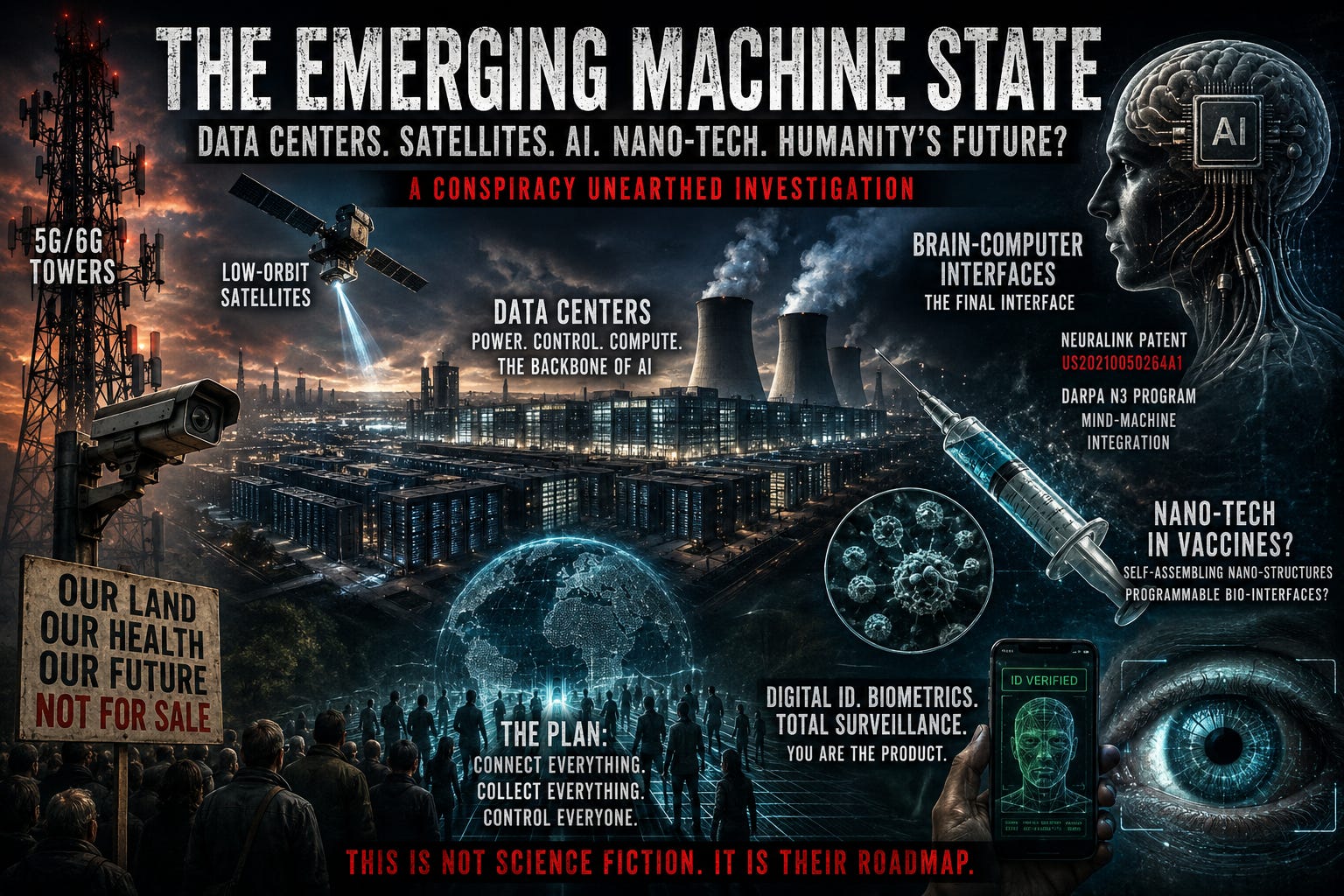
On May 13, 2026, author and conspiracy researcher David Icke published a post on X that rapidly spread across alternative media circles and independent political communities.
David Icke X Post:


Related Georgia Resident Video Referenced By Icke:

The post centered around a Georgia resident protesting infrastructure expansion tied to data centers, electrical easements, and energy projects connected to the exploding artificial intelligence industry. The post centered around a Georgia resident protesting the expansion of infrastructure linked to data centers and electrical easements. But the broader claim went much further.
Icke argued that modern data centers, low-orbit satellites, 5G and future 6G networks, artificial intelligence systems, biometric identification, and emerging neurotechnology were all pieces of a rapidly forming technological control structure capable of fundamentally reshaping human society.
Many immediately dismissed the post as paranoia.
Others saw something deeper.
Because beneath the dramatic language is a real and undeniable truth: powerful corporations, governments, defense contractors, and billionaire technologists are building an unprecedented global technological infrastructure capable of monitoring, analyzing, predicting, and potentially influencing human behavior on a scale never before seen in history.
The question is no longer whether the infrastructure exists.
The question is what it eventually becomes.
The Data Center Explosion
The modern world runs on data centers.
Artificial intelligence, cloud computing, online banking, military systems, social media, streaming platforms, surveillance systems, smart devices, autonomous vehicles, and digital communications all depend on massive computational infrastructure.
Data centers are the industrial backbone of the digital age.
As AI systems become exponentially more powerful, demand for electricity and computing power is exploding.
Entire communities across the United States are now confronting the consequences:
rising energy demand,
water consumption,
land seizures,
environmental strain,
and massive corporate influence over local governments.
In Georgia, local activists have protested the expansion of infrastructure tied to large-scale data center growth. Citizens have raised concerns about eminent domain, electrical easements, environmental degradation, and corporate influence.
What many residents see is not merely construction.
They see the creation of a permanent machine infrastructure designed to power artificial intelligence systems that may eventually dominate economic, political, and informational life.
And they are not entirely wrong.
According to industry projections, AI data centers could soon consume staggering amounts of electricity globally.
These facilities are not ordinary warehouses.
They are the industrial nervous system of the emerging AI era.
Related Reading:
https://www.tomshardware.com/tech-industry/georgia-data-center-used-29-million-gallons-of-water
https://www.reuters.com/world/us/us-data-center-boom-driving-surging-power-demand-2025-04-18/
The Satellite Grid
At the same time data centers are expanding on the ground, thousands of low-orbit satellites are being launched into space.
Companies such as SpaceX, Amazon, and OneWeb are racing to create continuous global connectivity.
The official justification is simple:
faster internet,
rural access,
autonomous systems,
military communications,
and global connectivity.
But critics argue something larger is forming.
The combination of:
satellites,
wireless towers,
AI systems,
cloud infrastructure,
biometric identification,
and always-connected devices
creates a planetary digital architecture unlike anything humanity has experienced before.
For the first time in history, a relatively small number of corporations possess the infrastructure to:
collect massive behavioral data,
monitor speech,
shape algorithms,
influence information flow,
analyze psychological patterns,
and potentially automate social governance.
Whether intentional or not, the result increasingly resembles a centralized digital nervous system.
The Rise of Artificial Intelligence Infrastructure
Artificial intelligence is no longer experimental.
It is rapidly becoming the dominant organizing technology of modern civilization.
Major technology companies are openly competing to build systems capable of:
replacing human labor,
mediating communication,
automating decision-making,
predicting behavior,
generating content,
and eventually operating autonomous agents.
The scale of investment is almost unimaginable.
Billions upon billions of dollars are flowing into:
AI chips,
GPU farms,
cloud architecture,
autonomous robotics,
biometric systems,
and neurotechnology.
This is not hidden.
It is public.
OpenAI CEO Sam Altman has discussed the possibility of transformative superintelligence.
Elon Musk has repeatedly warned about the dangers of uncontrolled AI while simultaneously funding Neuralink, Tesla AI systems, xAI, and advanced robotics.
Microsoft, Google, Amazon, Meta, and numerous governments are now engaged in a technological arms race centered around artificial intelligence supremacy.
The implications are profound.
AI systems increasingly mediate:
what people read,
what they see,
how they communicate,
how they work,
and eventually how they interact with reality itself.
The concern many critics raise is not merely technological.
It is civilizational.
If intelligence itself becomes centralized through a handful of corporations and government partnerships, then human autonomy may slowly become dependent upon systems ordinary people neither control nor fully understand.
Brain-Computer Interfaces and Human Integration
One of the most controversial areas of modern technology is the development of brain-computer interfaces.
Once dismissed as science fiction, these technologies are now being openly developed by:
Neuralink,
DARPA,
Synchron,
Precision Neuroscience,
Paradromics,
and numerous research institutions.
The stated goals vary:
helping paralyzed patients,
restoring communication,
assisting neurological disorders,
treating blindness,
and eventually enabling direct communication between humans and machines.
Neuralink openly describes its long-term vision as enabling deeper human-AI interaction.
Official Neuralink Site:
Neuralink Research Paper:
https://pmc.ncbi.nlm.nih.gov/articles/PMC6914248/
DARPA’s N3 program openly discusses non-surgical brain-machine interfaces for military applications.
DARPA N3 Program:
https://www.darpa.mil/research/programs/next-generation-nonsurgical-neurotechnology
For critics of emerging technocracy, this is where alarm bells begin ringing.
Because the idea of direct interfaces between the human brain and digital systems fundamentally alters the relationship between humans and technology.
Historically, humans used tools.
Now technologists are increasingly discussing integrating technology directly into human cognition itself.
That is not conspiracy theory.
That is public policy, corporate investment, military research, and active technological development.
The Patent Trail
One reason alternative researchers continue investigating these topics is because many technologies associated with neurotechnology and AI integration are openly patented.
Patents do not prove malicious intent.
But they do demonstrate active development.
Some of the more frequently discussed examples include:
Brain-Machine Interface Patent:
https://patents.google.com/patent/US20180333587A1/en
Deep Mind Analysis Patent:
https://patents.google.com/patent/US20200222010A1/en
Neural Dust Research:
https://www.darpa.mil/news/2016/implantable-neural-dust
These systems involve research into:
neural mapping,
wireless interfaces,
brain signal analysis,
cognitive monitoring,
and communication between biological and digital systems.
To some observers, this appears to be the early architecture of a future in which human thought itself becomes increasingly digitized.
Others argue these technologies will simply become advanced medical tools.
Either way, the implications are enormous.
Biometric Identity and the Digital Human
At the same time brain-interface technologies are developing, biometric identity systems are rapidly expanding.
Governments and corporations increasingly seek:
facial recognition,
iris scanning,
behavioral tracking,
voice recognition,
digital identity verification,
and AI-assisted authentication systems.
Projects like Worldcoin, associated with Sam Altman, have drawn both praise and criticism for using iris scans as a form of identity verification.
Worldcoin / World:
Supporters claim biometric systems help prevent fraud and distinguish humans from AI bots.
Critics warn they could become the foundation of a permanent digital identity infrastructure tied to:
finance,
internet access,
healthcare,
employment,
and social participation.
In such a system, participation in modern life could increasingly depend on centralized digital verification.
For many observers, this resembles the emergence of a technocratic governance model in which access, identity, communication, and even economic participation become inseparable from digital infrastructure.
The Vaccine Debate and Nanotechnology Claims
Perhaps the most controversial aspect of David Icke’s broader argument involves claims surrounding vaccines and nanotechnology.
During and after the COVID era, some researchers, activists, and independent investigators raised concerns about the long-term implications of advanced biomedical technologies, lipid nanoparticles, programmable medicine, and bio-digital convergence.
Mainstream institutions strongly reject claims that approved COVID vaccines contain self-aware or self-replicating nanotechnology designed for mind control.
However, critics point to broader trends involving:
nanomedicine,
targeted drug delivery systems,
bioelectronics,
programmable biological interfaces,
and military interest in human enhancement technologies.
There is legitimate scientific research into nanoscale biomedical engineering.
Nanotechnology itself is real.
Research institutions around the world openly explore:
nanosensors,
nanoparticle drug delivery,
injectable monitoring systems,
and bio-integrated electronics.
Examples:
https://www.nibib.nih.gov/science-education/science-topics/nanotechnology
https://www.nature.com/subjects/nanotechnology
The question critics raise is not whether nanotechnology exists.
It clearly does.
The debate centers on:
transparency,
long-term implications,
informed consent,
and whether increasingly advanced biomedical systems could eventually merge with broader digital infrastructures.
That concern intensifies when viewed alongside:
biometric identity systems,
AI governance,
neural interfaces,
and centralized cloud infrastructure.
Surveillance Capitalism and Behavioral Engineering
Long before the AI boom, scholars were already warning about surveillance capitalism.
The term refers to the monetization of human behavior through data collection.
Every click.
Every search.
Every location ping.
Every interaction.
Modern platforms harvest vast amounts of psychological and behavioral information.
Artificial intelligence dramatically amplifies this capability.
Algorithms now:
recommend information,
shape attention,
filter content,
analyze emotion,
and increasingly predict behavior.
Social media systems are not neutral.
They are engineered environments designed to maximize engagement and behavioral influence.
Critics argue this creates a subtle form of digital conditioning in which populations are increasingly guided by algorithmic systems optimized for control, profit, persuasion, or ideological influence.
The concern is no longer hypothetical.
AI systems are already deeply embedded in:
advertising,
search engines,
news feeds,
recommendation systems,
workplace productivity,
and political messaging.
The next stage may involve even deeper integration.
The Human Question
At the center of this entire debate lies a deeper philosophical issue.
What happens when humanity becomes inseparable from machine systems?
What happens when:
thought is mediated by AI,
identity becomes digital,
communication becomes algorithmic,
and cognition itself becomes technologically integrated?
Some technologists see liberation.
Others see dependency.
Some envision medical miracles.
Others fear unprecedented systems of centralized influence.
David Icke’s language may be provocative.
But beneath the sensationalism lies a real civilizational question:
Will technology remain a tool used by humanity?
Or will humanity gradually reorganize itself around systems controlled by technological institutions beyond democratic accountability?
That question is no longer science fiction.
It is already unfolding.
Conclusion: The Infrastructure of the Future
The emerging technological order is not a single conspiracy directed from a hidden room.
It is something potentially more complex and more powerful.
It is the convergence of:
AI systems,
data centers,
satellites,
cloud infrastructure,
biometric identity,
behavioral surveillance,
neurotechnology,
and centralized computational power.
Each component develops for its own stated purpose.
But together they create a civilization increasingly mediated through machine systems.
The concern many people now share is not merely about technology itself.
It is about power.
Who owns the infrastructure?
Who controls the algorithms?
Who governs the data?
Who defines acceptable speech?
Who determines digital identity?
Who regulates artificial intelligence?
And what happens when human cognition itself becomes part of the network?
These are no longer fringe questions.
They are among the defining questions of the twenty-first century.
David Icke’s post resonated because it touched a growing intuition shared by millions of people across the political spectrum:
that humanity may be approaching a turning point where technology ceases to simply surround human life and instead begins restructuring human civilization itself.
Whether that future becomes liberation or control may depend entirely on whether societies confront these questions now — before the infrastructure becomes too vast, too centralized, and too deeply embedded to challenge.

Deployed / Living it, DAILY 🤬 w/ Faces practicing on me……
One thing the image contains... Our future is not for sale. "They" are not going to offer to buy it. It will be taken in the name of safety and security.