
Operation Underworld: When the U.S. Navy Made a Deal with the Mafia

Introduction: The Unlikely Alliance Beneath the Docks
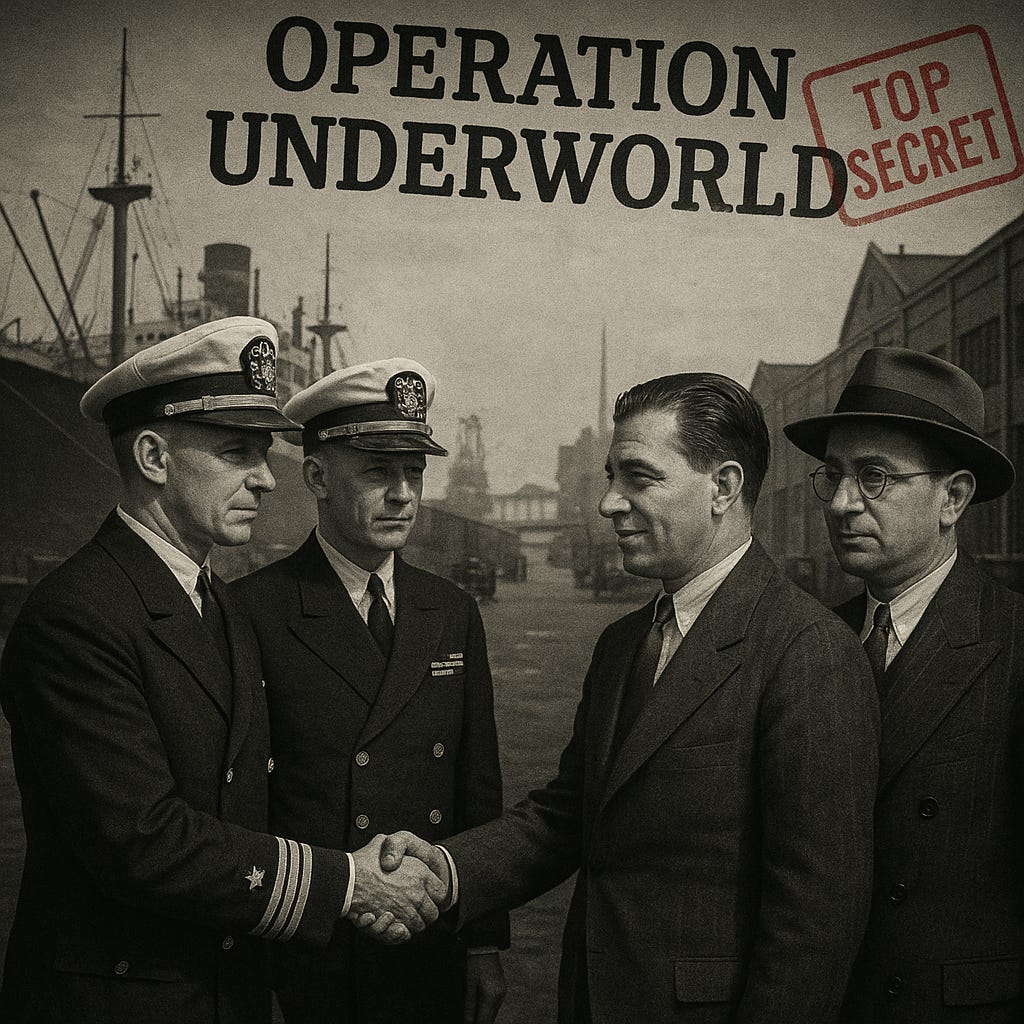
In the dark waters of World War II, when Nazi U-boats lurked just off the American coast and Axis spies were rumored to be everywhere, the United States Navy struck an alliance that sounds almost cinematic. It was called Operation Underworld, and it paired America’s maritime intelligence officers with its most powerful criminal organization — the Italian-American Mafia.
What began as a desperate wartime measure to protect New York Harbor became one of the most controversial covert operations in U.S. history — a story of sabotage, subterfuge, and moral compromise that blurred the line between patriotism and criminality.
I. The Spark: A Fire That Shook the Harbor
The story begins on February 9, 1942, when the SS Normandie, a captured French luxury liner being refitted for wartime troop transport, caught fire while docked at Pier 88 in New York Harbor. Within hours, the 1,000-foot ship — one of the largest ever built — capsized in the icy Hudson River. The cause was never proven.
At the time, the U.S. was barely two months into the war. German submarines were sinking American cargo ships at an alarming rate, sometimes within sight of the coastline. The inferno aboard the Normandie convinced Navy intelligence that Axis saboteurs had infiltrated America’s most vital port.
To fight an unseen enemy, the Office of Naval Intelligence (ONI) needed intelligence from within — and that meant dealing with the only people who truly controlled the docks: the Mafia.
II. The Problem: Spies, Strikes, and the “Waterfront Syndicate”
By 1942, the docks of New York and New Jersey were a world unto themselves — a maze of piers, warehouses, and longshoremen’s unions ruled by mobsters like Joseph “Socks” Lanza and Albert Anastasia. The docks were both indispensable and chaotic: plagued by theft, work stoppages, and pervasive corruption.
The ONI feared that Nazi agents could easily bribe or infiltrate dockworkers, who spoke a mix of Italian and Sicilian dialects and often distrusted outsiders. Even the FBI had little access.
Commander Charles R. Haffenden of the ONI’s Third Naval District came up with a radical solution: if you can’t beat the mob — recruit them.
III. The Deal: Lucky Luciano’s Second Act
To reach the top of the criminal pyramid, ONI needed intermediaries. Through a series of back-channel meetings, Haffenden’s agents made contact with Meyer Lansky, the Jewish-American gangster and strategist behind much of organized crime’s financial empire. Lansky, patriotic and fiercely anti-Nazi, brokered an introduction to the one man who could deliver complete control of the docks:
Charles “Lucky” Luciano.
Luciano, the legendary founder of the American Mafia Commission, was serving a 30- to 50-year sentence in Dannemora Prison for running New York’s prostitution rackets. Yet even behind bars, he remained the de facto boss of bosses.
The Navy made a proposal: in exchange for cooperation in protecting New York Harbor, Luciano’s sentence could be reduced and his prison conditions improved. According to later court documents, Luciano agreed — not just out of self-interest but out of what he reportedly called “a duty to America.”
IV. Operation Underworld in Action
With Luciano’s blessing, ONI agents and mob lieutenants established control of the docks almost overnight. Longshoremen were ordered to end strikes, report suspicious activity, and ensure that all cargo moved smoothly. Through informants, the Navy gained a clear picture of who came and went from the waterfront.
Mob-connected dock boss Joseph “Socks” Lanza, who ran the Fulton Fish Market, became a key ONI informant. His crew monitored the harbor for Axis infiltration, and Lanza was even issued an official U.S. government badge for “wartime services.”
The results were immediate:
No further incidents of sabotage were reported on the East Coast.
Dockside efficiency improved.
Organized crime gained an unprecedented veneer of legitimacy.
Behind the scenes, Operation Underworld operated out of a secret Naval Intelligence office at 90 Church Street, a nondescript Manhattan building that would later house federal agencies involved in other clandestine programs.
V. From New York to Sicily: The Invasion Connection
Perhaps the most enduring legend linked to Operation Underworld is its connection to the 1943 Allied invasion of Sicily — known as Operation Husky.
According to postwar testimonies, ONI and the Office of Strategic Services (OSS, precursor to the CIA) leveraged Luciano’s Sicilian Mafia contacts to facilitate the Allied landings. Mob bosses on the island allegedly provided maps, local intelligence, and helped secure key ports like Palermo.
While definitive documentation remains elusive, several wartime reports reference “Italian sources of exceptional value.” General George S. Patton’s troops met surprisingly little resistance in areas historically dominated by the Sicilian Mafia — leading some historians to speculate that Luciano’s influence reached across the Atlantic.
After the invasion, many known Mafiosi were appointed as mayors and officials by the U.S. military government in Sicily, effectively restoring the Mafia’s pre-Fascist power. Critics argue this was the birth of the postwar Mafia resurgence.
VI. After the War: Freedom for a “Patriot”
When the war ended, Navy officials submitted glowing reports on Luciano’s cooperation. In 1946, New York Governor Thomas E. Dewey — the very man who had prosecuted him — commuted Luciano’s sentence. Dewey’s statement praised Luciano’s “wartime assistance,” though the details remained classified.
The release was politically explosive. Newspapers exposed the deal, sparking outrage that a mob boss had been rewarded for “patriotism.” Luciano was deported to Italy, where he continued to oversee trans-Atlantic narcotics trafficking until his death in Naples in 1962.
The official files of Operation Underworld were sealed for decades, hidden under naval secrecy clauses. Portions were finally declassified in the 1970s, revealing a murky collaboration between U.S. intelligence and organized crime that set a precedent for future covert partnerships.
VII. Moral Gray Zones: National Security Meets Organized Crime
At its core, Operation Underworld was a moral paradox. Supporters called it a pragmatic wartime necessity — a case of using the tools available to win a global war. Critics saw it as the legitimization of the Mafia, a decision that entrenched corruption in American labor unions and ports for generations.
Key criticisms included:
Empowerment of Mob-controlled unions (notably the International Longshoremen’s Association).
Corruption of public officials, who later took bribes from the same mobsters once “patriotic.”
Loss of trust in government ethics, as citizens learned their Navy had struck deals with gangsters.
Former ONI officer Haffenden later defended his actions, claiming, “You don’t pick your friends in war — only your enemies.”
VIII. A Template for Future Covert Alliances
Operation Underworld was far from the last time U.S. intelligence partnered with organized crime. Its success — or at least its usefulness — became a template for later covert operations:
CIA–Mafia Plots Against Fidel Castro (1960s)
The CIA recruited mobsters like Sam Giancana and John Roselli to assassinate the Cuban leader, using the same underworld networks first courted in WWII.Corsican Syndicates and French Indochina (1940s-50s)
U.S. and French intelligence relied on Corsican gangsters to fight Communist dockworkers and fund anti-Soviet operations.Iran-Contra and Narcotics Channels (1980s)
Allegations later surfaced that intelligence networks again tolerated criminal smuggling to fund covert wars — echoing the logic of Operation Underworld’s “means to an end.”
Each episode raised the same question: When the government partners with criminals in the name of security, who really wins?
IX. Declassified Truths and Persistent Myths
Documents released under the Freedom of Information Act (FOIA) reveal much — but not all — of Operation Underworld’s scope. Some files remain redacted, especially those dealing with Mediterranean operations.
Historians like Tim Newark and Richard N. Billings have chronicled the operation, noting that while the Mafia did provide genuine intelligence, its greater benefit was labor control, not espionage. Others claim that Luciano’s supposed help in Sicily has been exaggerated — a convenient myth to justify his release.
Yet the conspiracy theories persist:
“The Mafia Saved New York Harbor” — a romanticized but enduring idea.
“The U.S. Handed Sicily Back to the Mob” — widely believed among Italian scholars.
“Underworld Networks Became Deep-State Assets” — echoed in Cold War literature connecting organized crime, intelligence, and covert funding.
X. Cultural Legacy: From Headlines to Hollywood
Operation Underworld’s shadow stretches across American culture. The story inspired books, documentaries, and even subplots in The Godfather Part II and Boardwalk Empire. Luciano’s commuted sentence became legend — the mobster who “helped America win the war.”
In the 21st century, the operation serves as an early example of state-sanctioned corruption, where “the enemy of my enemy” logic justified alliances that might otherwise have been unthinkable.
The parallels with modern covert programs — from arming rebel groups to working with private militias — remain striking.
XI. The Untold Cost
While the Navy averted sabotage, the long-term cost was the entrenchment of organized crime in postwar America. The same docks “secured” by Operation Underworld became breeding grounds for racketeering and labor exploitation through the 1950s and ’60s.
By empowering mobsters as wartime allies, the government inadvertently built a parallel shadow economy — one that influenced politics, construction, and unions for decades.
In hindsight, Operation Underworld reveals how easily democratic institutions can compromise themselves under the banner of national security. Once such alliances are formed, they rarely disappear.
XII. Conclusion: Patriotism in the Shadows
Operation Underworld remains one of history’s most audacious deals — the moment when the U.S. Navy, desperate to secure its shores, turned to the criminal underworld for salvation. In the short term, it worked. Sabotage ceased. Ships sailed. America won the war.
But in the long term, it blurred the moral compass of a nation that prided itself on justice and law. It set the stage for future covert marriages between government power and criminal enterprise — partnerships that would echo from Havana to Saigon, from Sicily to Washington D.C.
Key Takeaways
CategoryDetailsCode NameOperation UnderworldYears Active1942 – 1946Lead AgencyOffice of Naval Intelligence (ONI)ObjectivePrevent Axis sabotage in U.S. portsKey PlayersCharles “Lucky” Luciano, Meyer Lansky, Cmdr. Charles Haffenden, Joseph LanzaOutcomeImproved port security, Luciano’s early release, Mafia’s lasting empowermentConspiracy LegacyAlleged Mafia assistance in Sicily invasion; CIA-mob collaboration model
Further Reading
The Luciano Project: The Secret Wartime Collaboration of the Mafia and the U.S. Navy by Rodney Campbell (1977)
Operation Underworld: How the Mafia and the U.S. Navy Beat the Axis by Matthew Black (2022)
The Commission and the U.S. Government: Cooperation and Corruption – FOIA Naval Intelligence Declassified Files, 1977 Release
**(Disclaimer: Artificial Intelligence Information and article-generated material)**
Follow on X @ Conspiracy Unearthed
Follow on Facebook @ Conspiracy Unearthed
Follow on Bluesky @ Conspiracy Unearthed
OR
Donate through PayPal - Your contribution is much appreciated, thank you.