
Operation Northwoods Exposed: The U.S. Plan for a False Flag War on Cuba

**(Disclaimer: Artificial Intelligence Information and article-generated material)**
In the annals of U.S. military history, few proposals have sparked as much controversy and debate as Operation Northwoods. Conceived at the height of Cold War tensions in 1962, this top-secret plan outlined a series of false flag operations designed to justify a U.S. military invasion of Cuba by fabricating evidence of Cuban aggression. While the plan was never implemented, its declassification decades later revealed the lengths to which some U.S. military leaders were willing to go to achieve geopolitical objectives, raising profound questions about ethics, transparency, and the use of state power. This article delves into the who, what, when, where, and why of Operation Northwoods, exploring its historical context, proposed actions, key figures, and lasting legacy.What Was Operation Northwoods?Operation Northwoods was a proposed covert operation drafted by the U.S. Department of Defense (DoD) and the Joint Chiefs of Staff (JCS) in 1962. The plan called for staging acts of terrorism and sabotage on U.S. soil and abroad, to be falsely attributed to Fidel Castro’s Cuban government. These fabricated incidents were intended to create a pretext for military intervention in Cuba, rallying domestic and international support by portraying Cuba as a reckless threat to peace in the Western Hemisphere. The operation included a range of deceptive tactics, from staged bombings and hijackings to sinking U.S. ships and simulating attacks on American civilians and military personnel.The plan was part of a broader anti-Castro initiative known as the “Cuba Project” or Operation Mongoose, which sought to destabilize or overthrow Castro’s regime following his 1959 revolution. The document, titled “Justification for U.S. Military Intervention in Cuba,” was presented to Secretary of Defense Robert McNamara on March 13, 1962, and was signed by JCS Chairman Lyman Lemnitzer. It outlined a series of “pretexts” designed to manipulate public opinion and provide “defensible grievances” for war, reflecting a Cold War mindset that prioritized strategic goals over ethical considerations.Who Was Involved?The primary architects of Operation Northwoods were high-ranking members of the U.S. military and intelligence community, operating under the auspices of the Joint Chiefs of Staff. Key figures included
:
Lyman Lemnitzer, Chairman of the Joint Chiefs of Staff: Lemnitzer, a decorated World War II general, led the drafting of the Northwoods proposal. His aggressive stance against communism and frustration with the Kennedy administration’s perceived restraint on Cuba shaped the plan’s audacious scope. After Kennedy rejected the proposal, Lemnitzer was removed as JCS Chairman in 1963 and reassigned as Supreme Allied Commander of NATO.
Joint Chiefs of Staff: The JCS, comprising the highest-ranking officers of the Army, Navy, Air Force, and Marine Corps, collectively endorsed the plan. Their involvement reflected a broader military consensus on the need to counter Castro’s regime, which they viewed as a Soviet proxy threatening U.S. interests.
Brigadier General Edward Lansdale: As the chief of operations for Operation Mongoose, Lansdale oversaw anti-Castro efforts, including Northwoods. His background in psychological warfare and covert operations influenced the plan’s emphasis on deception and media manipulation.
President John F. Kennedy: While not an architect of the plan, Kennedy played a critical role in its rejection. His administration, wary of escalating Cold War tensions and skeptical of military overreach, deemed the proposals unethical and unacceptable.
Robert McNamara, Secretary of Defense: As the recipient of the Northwoods memorandum, McNamara reviewed the plan and, aligned with Kennedy’s stance, rejected its implementation. His oversight ensured civilian control over military initiatives.
The Central Intelligence Agency (CIA) was also implicated, as the plan relied on CIA operatives to execute many of the proposed actions, leveraging their expertise in covert operations honed during the Bay of Pigs invasion and other anti-Castro efforts.When Did It Happen?Operation Northwoods was conceived and documented in early 1962, with the formal memorandum presented to McNamara on March 13, 1962. The plan emerged in the aftermath of the failed Bay of Pigs invasion (April 1961), which had humiliated the U.S. and strengthened Castro’s position. The timing was critical: the Cuban Missile Crisis, which would bring the U.S. and Soviet Union to the brink of nuclear war, was still months away (October 1962). The JCS, frustrated by diplomatic and covert failures, sought a decisive military solution to the “Cuba problem.”The plan remained classified for over three decades, with its existence unknown to the public until November 18, 1997, when the John F. Kennedy Assassination Records Review Board declassified it under the JFK Assassination Records Collection Act. The National Security Archive, in collaboration with CNN’s Cold War documentary series, published key sections in 1998, and a fuller release followed in 2001, sparking widespread media coverage and public debate.Where Was It Planned?Operation Northwoods was developed at the Pentagon, the headquarters of the U.S. Department of Defense in Arlington, Virginia. The planning occurred within the secretive confines of the JCS and DoD, with input from Operation Mongoose’s leadership. The proposed actions targeted multiple locations:
United States: The plan called for staged terrorist attacks in U.S. cities, particularly Miami and other Florida cities with large Cuban exile communities, as well as Washington, D.C. These areas were chosen for their symbolic and media impact, as attacks on American soil would maximize public outrage.
Guantanamo Bay, Cuba: The U.S. naval base at Guantanamo was a focal point for proposed sabotage, including sinking a U.S. ship (real or drone) and staging mortar attacks to simulate Cuban aggression.
Caribbean and International Waters: The plan included scenarios for sinking ships or staging aircraft incidents in Cuban waters or international airspace to frame Cuba as a maritime and aviation threat.
Other Countries: Proposals extended to staging attacks in allied nations, such as Jamaica or other members of the Organization of American States, to depict Cuba as a regional menace and rally international support.
The geographic scope underscored the plan’s ambition to create a global narrative of Cuban hostility, leveraging U.S. and allied territories to justify intervention.Why Was It Proposed?The “why” of Operation Northwoods lies in the geopolitical and ideological context of the early 1960s. Fidel Castro’s rise to power in 1959, following his overthrow of U.S.-backed dictator Fulgencio Batista, transformed Cuba into a communist stronghold aligned with the Soviet Union. Castro’s nationalization of American businesses, expulsion of U.S. influence, and acceptance of Soviet military aid—culminating in the deployment of nuclear missiles in 1962—made Cuba a focal point of U.S. anxiety during the Cold War. The failed Bay of Pigs invasion in 1961, a CIA-led operation to topple Castro, left the U.S. desperate for new strategies to eliminate the perceived threat 90 miles from Florida.The JCS and anti-Castro hawks within the military believed that diplomacy and covert operations were insufficient. They sought a direct military intervention but recognized that neither the American public nor the international community would support an unprovoked war. Operation Northwoods was thus designed to manufacture a casus belli—a justifiable reason for war—through false flag operations that would shift blame to Cuba. The plan drew inspiration from historical precedents like the 1898 USS Maine explosion, which spurred the Spanish-American War, and reflected a willingness to sacrifice American lives and assets to achieve strategic goals.The broader “Cuba Project” aimed to destabilize Castro’s regime through propaganda, sabotage, and assassination attempts, but Northwoods represented an escalation, proposing overt acts of deception to provoke war. The JCS argued that these pretexts would provide “irrevocable proof” of Cuban aggression, ensuring domestic and international backing for military action.Key Proposed ActionsThe Northwoods memorandum outlined a chilling array of false flag operations, emphasizing plausibility and media impact. Key proposals included:
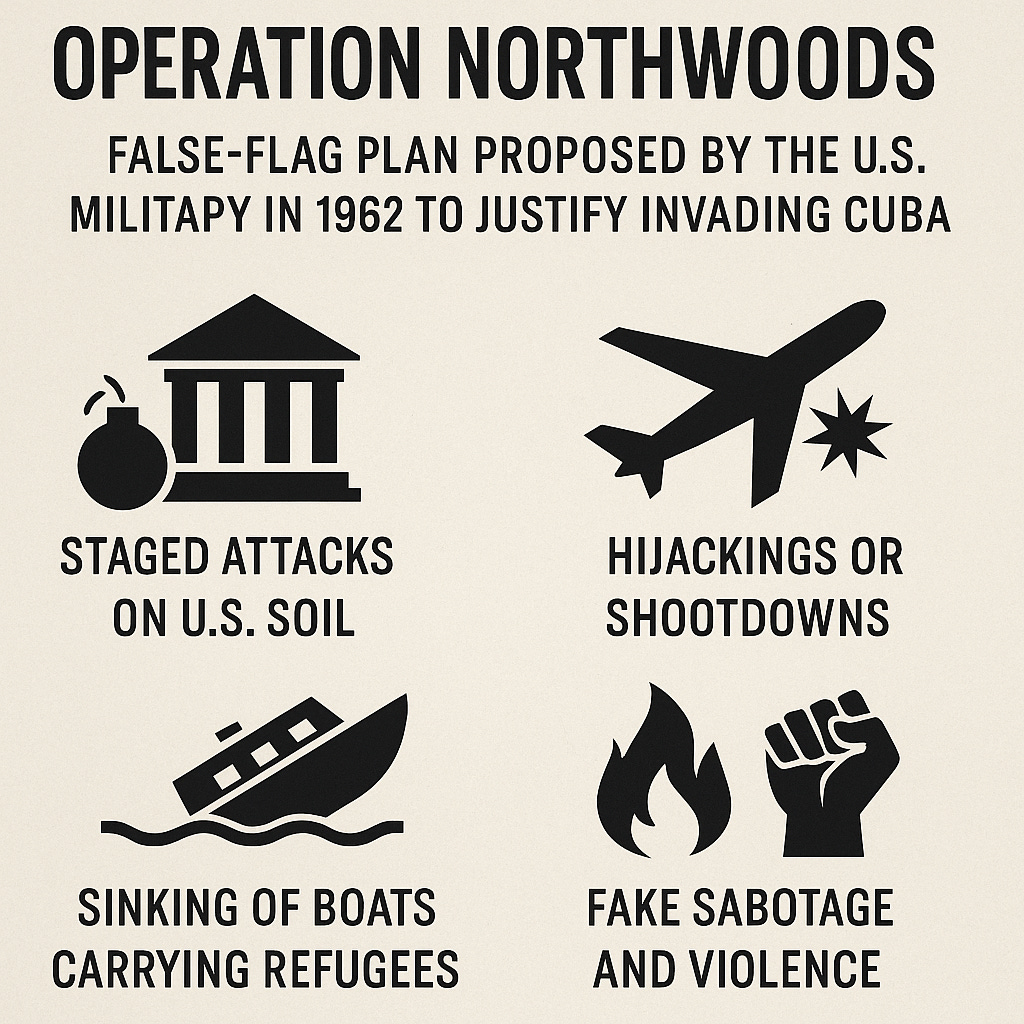
Staged Terrorist Attacks: A “Communist Cuban terror campaign” in U.S. cities like Miami and Washington, D.C., involving bombings, assassinations of Cuban exiles, and sinking refugee boats. Casualty lists would be published to stoke public outrage.
Aircraft Incidents: Staging the shoot-down of a civilian airliner or military jet, potentially by swapping a chartered plane with a drone that would broadcast a distress signal before being destroyed remotely. Another plan involved faking a Cuban attack on a U.S. Air Force plane.
Naval Sabotage: Sinking a U.S. ship in Guantanamo Bay, reminiscent of the USS Maine, or blowing up ammunition at U.S. bases to simulate Cuban sabotage. Staged riots by “friendly” Cubans would add to the narrative.
Psychological Operations: Spreading rumors, forging documents, and staging attacks in allied nations to depict Cuba as a regional threat. One scenario involved bribing a Cuban commander to attack U.S. forces, creating a pretext for retaliation.
These actions relied on CIA operatives, media manipulation, and psychological warfare to ensure the world believed Cuba was responsible.Outcome and LegacyPresident Kennedy rejected Operation Northwoods on March 16, 1962, finding its proposals morally and legally unacceptable. His administration prioritized diplomatic solutions, especially after the Cuban Missile Crisis later that year, which underscored the risks of escalation. The rejection highlighted tensions between the military and civilian leadership, with some JCS members viewing Kennedy as “soft” on communism.The plan’s declassification in 1997, followed by its publication in 2001, shocked the public and fueled debates about government ethics. Investigative reporter James Bamford, in his book Body of Secrets, described it as one of the “most corrupt” plans ever devised by the U.S. government, highlighting the military’s willingness to deceive its own citizens. Cuba’s National Assembly condemned it as evidence of U.S. aggression, while some commentators drew speculative parallels to later events like 9/11, though such claims lack evidence.Operation Northwoods remains a stark reminder of the Cold War’s moral ambiguities, where fear of communism drove extreme proposals. It underscores the importance of civilian oversight, transparency, and ethical boundaries in national security. The declassified documents, available at the National Security Archive (nsarchive2.gwu.edu/news/20010430/), offer a window into a dark chapter of U.S. history, prompting ongoing reflection on the limits of state power in times of crisis.
**(Disclaimer: Artificial Intelligence Information and article-generated material)**
I’m on @buymeacoffee. If you like my work, you can buy me one and share your thoughts 🎉☕. https://buymeacoffee.com/conspiracyunearthed
OR
Follow the blog at Conspiracy@ Unearthed
Follow on X @ Conspiracy Unearthed
Follow on Facebook @ Conspiracy Unearthed
Follow my posts on YouTube @ Conspiracy Unearthed